The World Agreed to Wait Out a Genocide
By Namrata R Samtani
In 1948, roughly 750,000 Palestinians were expelled or fled their homes as the state of Israel was established. More than 500 of their towns and villages were destroyed. Palestinians call it the Nakba. The catastrophe. Seventy-eight years later, the United Nations still describes it as an unresolved refugee crisis, one that continues to shape Palestinian lives and the pursuit of justice and self-determination.
What is happening in Gaza today is not a rupture from that history. It is its most brutal chapter.
Since October 2023, at least 70,373 Palestinians have been killed in Gaza. At least 20,179 of them were children.
Sit with that number for a moment. Twenty thousand, one hundred and seventy-nine children.
Even after a ceasefire took effect in October 2025, the killing did not stop. Roughly one child has died, on average, every single day since, under an agreement that was supposed to end exactly this. A ceasefire that still leaves a child dead every day is not peace. It is a pause in which Palestinians are still expected to survive.
None of it was an accident.
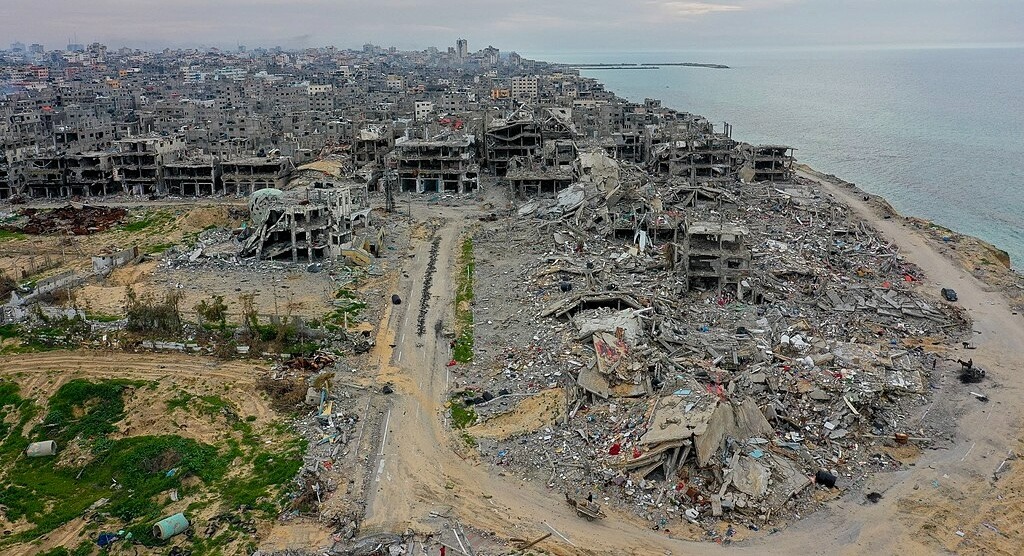
Nor is it only about the dead. As of late August, 58 percent of Gaza's population faced critical or catastrophic shelter needs. Ninety-four percent required shelter assistance just to survive. This is what remains for the living: no home to return to, no certainty that tomorrow's shelter will still be standing.
Occasionally, a single death breaks through the numbness of twenty thousand others.
Five-year-old Hind Rajab was trapped in a car. Her relatives were already dead around her. An Israeli tank was approaching. She called an emergency dispatcher.
"I'm so scared," she said. "Please come."
The ambulance sent to save her was fired on too. She did not survive.
For years, her death remained disputed. Israel denied its forces were even present. Then, in August 2026, its military finally acknowledged that its troops were responsible for the deaths of Hind and her family and opened a criminal investigation.
Her case is not exceptional because what happened to her was unusual. It is exceptional because it was documented well enough that the world could not easily look away. Of all the children killed in Gaza, most will never have a recording, a satellite image, or a bullet count entered into the public record. Their deaths simply add to a total and then vanish into the next day's news cycle.
Language does some of this work too. People become casualties. Homes become damaged structures. Families become displaced populations. Children become numbers in a report. The numbers matter. They show the scale. But they were never meant to replace the people standing behind them.
None of this is happening in a vacuum of ignorance. The International Court of Justice found, back in January 2024, a "plausible risk" that Israel's actions in Gaza breach the Genocide Convention. It ordered Israel to prevent genocidal acts and let humanitarian aid in.
Israel's prime minister called the ruling "outrageous." Said no one would stop the campaign. Not the Hague. Not anyone.
The killing did not stop.
South Africa's full genocide case is still before the court. Eighteen countries have joined it since. A UN commission of inquiry concluded, last year, that genocide has in fact been committed, a word bodies like this one do not use lightly, and do not use often.
The killing did not stop.
The International Criminal Court issued arrest warrants for Israel's prime minister and former defense minister in November 2024.
The killing did not stop.
By most expert estimates, a final ICJ judgment will not arrive until 2027 or 2028. If it comes on the timeline, these cases usually keep at all. Bosnia v. Serbia took fourteen years to reach a verdict. Croatia v. Serbia took sixteen. Somewhere in the years it will take the world's courts to finish writing their findings, more children in Gaza will have been born, grown old enough to understand what happened to them, and possibly died themselves, all before a single verdict is read aloud.
That is what accountability looks like here. Paperwork moving at the speed of paperwork, while a child grows up in the space between a ruling and a verdict.
But Palestinians do not live in that space on paper. They live in it. They wake up surrounded by destroyed buildings. They search for food, for medicine, for somewhere safe to sleep. They try to keep their children alive in a place where even the most ordinary parts of childhood are difficult to protect.
The evidence is there. The findings are in.
What is missing is simpler than any of it. The will. Among the states with the power to act, the will has simply not been there.
Governments that call themselves allies of international law continue selling weapons. Governments that call themselves defenders of human rights continue offering diplomatic cover. The mechanisms everyone points to when asked, "Isn't something being done?" do exist. They exist in The Hague, in the halls of the UN, on paper. They are not nothing. But they are not, on their own, a response proportionate to more than 20,000 dead children.
There is a word for watching all of this happen, in real time, with the evidence in hand, and still choosing not to act: complicity. Not only the complicity of the soldier who pulls the trigger. A quieter one. The complicity of every government with the power to end an arms sale, suspend a trade agreement, or say plainly what a UN commission has already said, that this is genocide, and instead issues a statement of "grave concern" and moves on to the next item on the agenda.
More than 20,000 children are dead. Tens of thousands more are injured, many permanently. A ceasefire has not stopped the dying; it has only slowed it to about one child a day.
This was never really a question of law. Law is only as strong as the will to enforce it. That will has been absent from the start.
What is happening in Gaza does not require a tribunal to be understood. It requires only the willingness to look at what has already been shown, and call it by its name.
That is not a legal argument. It is not really a political one, either.
We have learned to watch suffering like this from a distance, a phone in hand, between ordinary tasks. We see it. We react. We move on. That habit is not neutral. It is a choice, made over and over again.
It is the most basic thing a person can be asked to do.
See what is in front of you. Do not look away.
0 Comments Add a Comment?