The Rooms We Stopped Building
By Namrata R Samtani
What is ayahuasca? The question sounds simple until you try to answer it. It is an Indigenous medicine. A religious sacrament. A subject of clinical research. A line item on a retreat center's website. Each of these is true. None of them alone is sufficient. That is not a failure of definition. It is the argument.
People have always searched for meaning. What has changed is where they look for it. For much of human history, meaning was largely embedded in a religion, a community, or a cosmology inherited before anyone was old enough to question it. That inheritance is thinning for a significant number of people, who are left to go looking for meaning somewhere else.
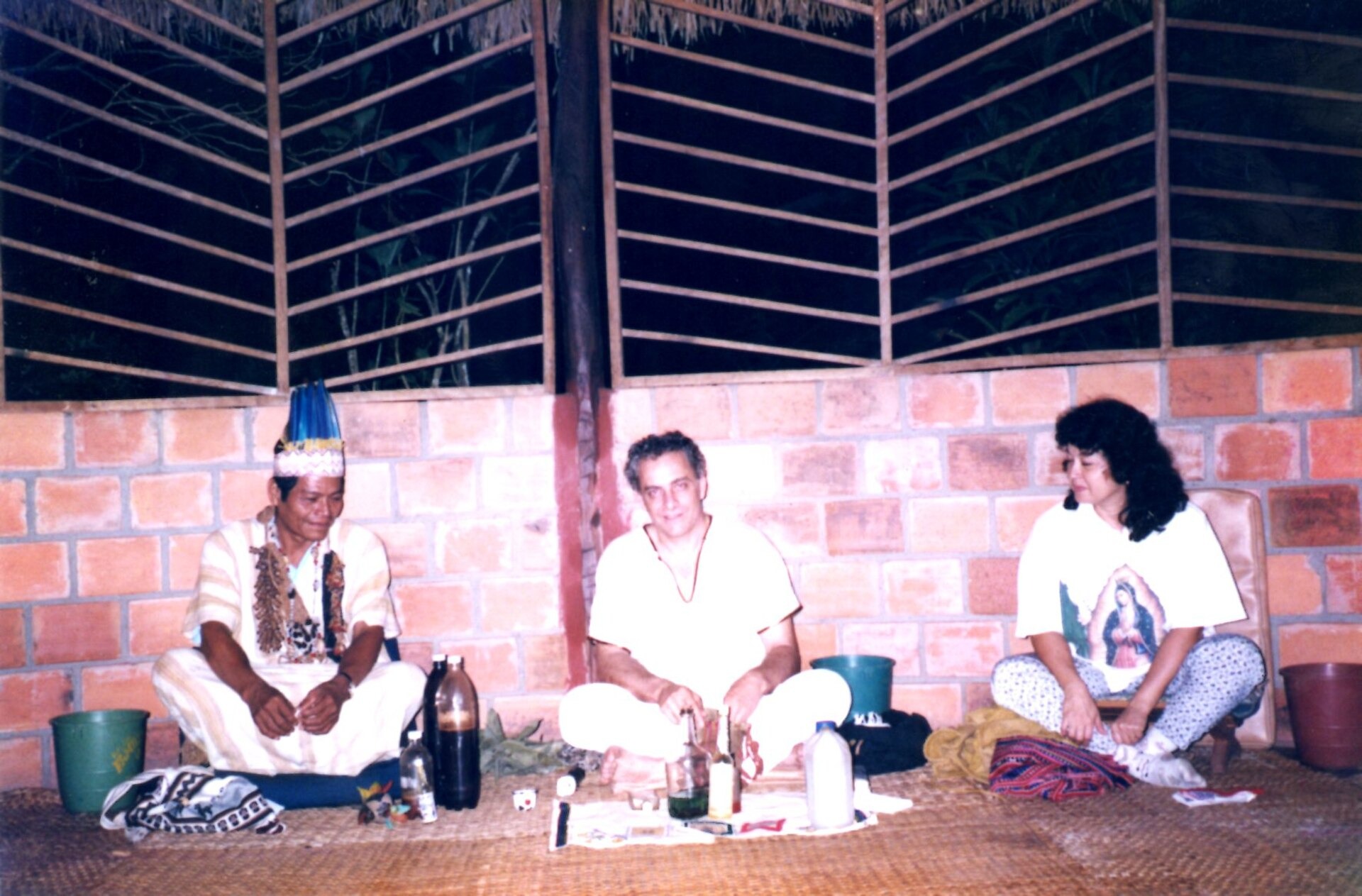
Ayahuasca sits inside that shift, and increasingly at its center. Rooted in generations of Amazonian tradition, ayahuasca now draws travelers from around the world. What brings them is often described in terms of healing, spirituality, self-understanding, and transformation, but there is another possibility worth considering: an experience of dissolution and reconnection that many modern societies provide few spaces for. Research on self-transcendent experiences has given this kind of altered relationship to the self a language of its own, while scholars have noted that such experiences have historically been associated with religious and ritual contexts.
Ayahuasca is not a blank vessel waiting to be filled with whatever meaning a traveler brings to it. Traditionally, it was never simply a healing tool. Different Amazonian communities have used it in a range of ritual, social, and spiritual practices, each within their own systems of belief. Its current export is not the region's first encounter with foreign demand. The history of the Amazon is also a history of commodities moving outward: rubber, cinchona, and other resources have each been drawn into wider markets at different moments. The parallel is not exact, but it is difficult to ignore. Here, two systems of meaning meet: the expectations carried by the visitor and the traditions surrounding the practice itself. Neither remains entirely unchanged.
That collision, rather than the pharmacology alone, is the real subject here. The evidence on what ayahuasca does to the people who seek it is more exacting, and more contested, than much of the wellness language surrounding it suggests. But the sharper question is what happens to a tradition asked, at this scale, to satisfy a longing that did not originate within it.
Meaning is not a mood. Psychologists who study it treat it as closer to a judgment: whether a life feels purposeful, worth living, and coherent. Research on meaning finds that people build that sense out of ordinary materials: belonging, authenticity, ritual, awe, and an honest reckoning with mortality. It is not a fixed possession, granted once and kept. It is built, and rebuilt, out of what a life actually contains.
Some of that work pushes past the boundaries of the self entirely. Yaden and colleagues call these self-transcendent states: temporary conditions in which the sense of an individual self-recedes while a sense of connection grows stronger. They range from the mild (such as flow, absorption, unexpected awe) to the intense: a dissolving of the ordinary boundaries of self that some who undergo it describe as mystical. This can happen regardless of whether they hold any religious faith. Self-transcendence doesn't require a church.
For a rising number of people, the church isn't where they're looking for one. Those who call themselves spiritual but not religious are not necessarily abandoning the underlying need, only the institution that used to house it. What pulls some of them away can be concrete: discomfort with institutional authority, dissatisfaction with religious doctrine or norms, or a preference for choosing their own practices rather than inheriting them. What they're after hasn't disappeared. It's unhoused.
Ayahuasca is one destination for that need. One of the few studies to interview ayahuasca tourists about their motivations found that six participants described healing, self-discovery, and curiosity. They called their experiences spiritual journeys. Some called them sacred rituals. But their own accounts rarely held a single line for long. The same encounter could sound like a religious rite in one description and a drug experience in another, depending on which part the person was trying to explain, and to whom.
That blur is worth sitting with rather than resolving too quickly. It points to a tension at the heart of this story: someone can want a night like that, walk away believing it delivered, and still have no proof that it did. That six-tourist study, for all the longing it documented, found no convincing evidence that ayahuasca produced any fundamental long-term change in participants' social outlook or behavior. The meaning was there before the evidence could establish what, if anything, had changed. None of this makes the desire less real. It only means wanting something and proving it are not the same act, and mistaking one for the other is where this story most often goes wrong.
Ayahuasca's effects begin in chemistry. The brew typically combines the vine Banisteriopsis caapi with the leaves of Psychotria viridis, known as chacruna. On its own, DMT (N,N-dimethyltryptamine) would ordinarily be broken down by an enzyme in the digestive system before it could take effect. The harmala alkaloids in the vine inhibit that enzyme, allowing DMT to become orally active and exert its psychedelic effects. That mechanism is well established. What happens once it arrives is where the science gets harder.
Ruffell and colleagues argue that the ceremony around ingestion is not merely decoration but part of what shapes the experience. Music, the physical environment, the guide's presence, and the expectations a person carries into the room can all influence what happens once the pharmacology meets a specific person in a given setting. Two people could take the same dose and walk away with very different experiences, not because the chemistry changed, but because everything around it did. Separating the drug from its setting, on this view, may be a mistake in kind, not just a missing detail.
Some effects can be measured after the fact. Sampedro and colleagues studied sixteen healthy volunteers with previous ayahuasca experience and found post-acute changes in brain connectivity and several neurochemical markers after a single dose. Some of these changes were associated with higher scores on measures of nonjudging and self-compassion, and certain neural changes were associated with higher nonjudging scores two months later. It is a genuinely striking finding. It is also a narrow one: sixteen people, no control group, no blinding, and a group already familiar with ayahuasca before the study began. The result can tell us something about what happened in these participants under these conditions. It cannot tell us what would happen in someone new to it, taking other medications, or approaching the experience with very different expectations.
That same limit applies to any conversation about safety. A systematic review by White and colleagues found that ayahuasca and DMT appear generally safe in the available literature, particularly among healthy populations and in controlled settings. The same review documented adverse events and identified conditions that may increase risk, including interactions with certain medications and potential problems related to higher doses and given health conditions. Animal and isolated-compound findings also raise additional concerns that cannot simply be transferred to ordinary human use. Put plainly, the evidence does not support either extreme. Ayahuasca is not the cure some retreat marketing promises, but neither does the available evidence justify treating it as inherently dangerous. Its risks depend on the substance, the dose, the person taking it, and the circumstances in which it is used.
Long before ayahuasca appeared on a retreat website, it moved through Amazonian life in ways the word “healing” only partly covers. Different Indigenous groups used it in divination, hunting, warfare, and the maintenance of social order, woven into systems of belief that gave the natural world its own voice and agency. It was not merely a private remedy. It belonged to individual peoples, and it answered to cosmologies that had little to do with a foreigner's inner life.
Even the word used to describe these practices carries a kind of distortion. Fotiou points out that “shamanism” itself is a Western category, stitched together from distinct traditions that developed in different places and under different histories, then flattened into one convenient label. The single wise shaman, timeless and untouched by the modern world, is less a description than a construction: an image outsiders often went looking for. Her own fieldwork in Iquitos found something closer to the opposite. The healers she met were not archetypes. They were people running businesses, raising families, and working within the social and economic realities of the place they lived in, whether their clients were tourists or neighbors. The romantic image made their work seem more removed from modern life than it was and made the real circumstances they worked under harder to see from the outside.
That past is not a gentle one. Fotiou situates today's ayahuasca practice inside a region reshaped by colonialism, missionary campaigns, and the rubber boom. Communities were displaced, enslaved, or killed. Some scholars she cites argue that ayahuasca's healing-focused role partly grew out of that violence, shaped through exchanges between Indigenous and mestizo communities in its aftermath. Fotiou is careful not to reduce the story to a single origin, noting that contact between Amazonian and Andean peoples likely predates the rubber era by a long stretch. But the violence is part of the record, whichever way the timeline runs.
None of this makes the encounter between ayahuasca and the wider world a simple story of loss or survival. Fotiou resists treating today's tourism as some new betrayal of those traditions; healers have exchanged knowledge across cultural lines for a long time, and outsiders have traveled in search of it for just as long. What has changed is the scale, and the imbalance built into who is doing the traveling. Globalization did not begin the moment ayahuasca crossed a border. It is the slower process by which different ideas about healing, spirit, and what ayahuasca is supposed to be keep meeting, and keep unsettling each other.
What was once part of local and regional exchange has become something closer to an industry. International visitors now travel to the Amazon seeking experiences they associate with healing, spirituality, and transformation, while ayahuasqueros increasingly travel the other way, bringing ceremonies to cities far beyond the Amazon. Retreat centers, online booking platforms, and word-of-mouth networks have turned this into a global circulation of people, knowledge, and money on a scale that would have been difficult to imagine a generation ago.
Once something enters a market, it tends to get packaged. Tupper places ayahuasca within a longer history of plants and substances pulled from their original contexts and remade into products: branded, advertised, sold online, and differentiated from competitors. Peluso widens the picture further, examining lodges, tour operators, training programs, and other businesses forming an entire economy around the brew. Access has genuinely expanded. So has the number of people profiting from it, including people with little connection to the traditions they now promote. Retreats competing for foreign clients have incentives to emphasize what those clients expect to find: healing, transformation, an aura of ancient and unaltered wisdom. The result is that commercialization does not simply distribute ayahuasca more widely. It shapes which version of it reaches the people paying for it.
The search for something “authentic” carries its own contradiction. Visitors may come to the Amazon looking for an experience untouched by the modern world. Their arrival is already reshaping the thing they came to find. Fotiou's research shows how this plays out on the ground: outsiders searching for a genuine shaman can find themselves in interactions already shaped by the tourism economy that has grown around that search. The global market does not only bring ayahuasca to new audiences. It can turn the very sense of difference those audiences seek into something they can buy.
None of this benefits people evenly. Shamanic tourism has created genuine income for some practitioners, enough for a few to build homes, buy land, or open lodges of their own. But the same growth widens gaps within local communities. Those who work mainly with tourists often earn far more than those still serving their neighbors, while foreign-owned operations can capture value built on local knowledge and labor. Peluso's picture is one where capital, infrastructure, and access to international buyers are distributed unevenly from the start. The market creates opportunity. It also leaves an old question in a new form: who controls the resources, the knowledge, and the profit that ayahuasca now generates?
There are three different kinds of claims people make about ayahuasca, and most writing on the subject collapses them into one. There is what a person experiences: the felt sense of dissolution, insight, communion, whatever word someone reaches for afterward. There is what can be observed: a measurable change in mood, brain activity, or behavior, tracked by someone other than the person it happened to. And there is what the evidence can establish: a finding supported strongly enough by the study design, the data, and the weight of evidence behind it. These are not the same things. Treating them as interchangeable is how good evidence turns into an overstated claim.
A person who feels transformed after a ceremony is describing a real experience, even if science cannot yet say exactly what produced it or how long its effects will last. A striking result in sixteen volunteers is an observation. It is not, on its own, an established fact about what ayahuasca does to the human brain in general. Prayag's six interviewees reporting perceived change is an observation about six people. It is not a finding about ayahuasca's power to transform anyone who drinks it.
This is not a call for cynicism. The felt experience matters, and dismissing it because it has not been formally validated would be its own error, an insistence that an experience has no value until a lab confirms it. But taking every reported transformation as settled fact does something worse: it turns anecdote into marketing, and marketing into expectation, and expectation into pressure on whoever sits down for their first ceremony believing the outcome is guaranteed.
There is a version of this piece that ends with reassurance. It would say that meaning is meaning, wherever it's found, and that a tradition capable of carrying spiritual and healing practices across generations can absorb a growing number of seekers without being diminished. That version is comforting. It is also not quite honest.
The truer ending is smaller and harder to sit with. Something is being asked of a practice that was never formed around this particular longing, at a scale no single tradition could have chosen. Some of what comes back is real: income, attention, even genuine transformation in the people who show up. But none of that settles whether the exchange is fair. Fairness was not the question the seekers were asking. They came for themselves. That is not a moral failure. It is simply not the same thing as an accounting of what the encounter costs the people whose lives are already tied to the tradition.
The plant itself will remain indifferent to who drinks it or why. The tradition will keep adapting. But change is not the same as freedom from cost. The impulse that brought people here will remain. People will keep looking for somewhere to put what they cannot otherwise carry. They will keep finding ayahuasca. What they are actually looking for, though, was never really about ayahuasca. It was about the rooms that stopped being built.
Sources
Michael F. Steger, “Making Meaning in Life”
David B. Yaden et al., “The Varieties of Self-Transcendent Experience”
Girish Prayag et al., “Drug or Spirituality Seekers? Consuming Ayahuasca”
Simon G. D. Ruffell et al., “Ayahuasca: A Review of Historical, Pharmacological, and Therapeutic Aspects”
Frederic Sampedro et al., “Assessing the Psychedelic ‘After-Glow’ in Ayahuasca Users”
Eleanor White et al., “Ayahuasca and Dimethyltryptamine Adverse Events and Toxicity Analysis”
Evgenia Fotiou, “The Globalization of Ayahuasca Shamanism and the Erasure of Indigenous Shamanism”
Kenneth W. Tupper, “Ayahuasca Healing Beyond the Amazon”
Daniela M. Peluso, “Global Ayahuasca: An Entrepreneurial Ecosystem”
0 Comments Add a Comment?