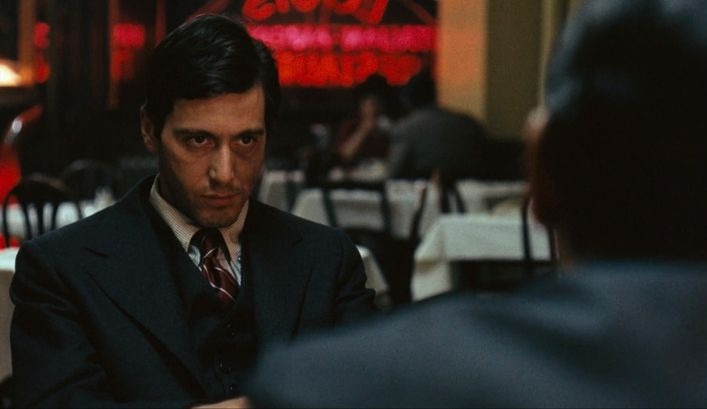
The Illusion of Identity: Michael Corleone and the Certainty of Knowing Ourselves
By Namrata R Samtani
“That’s my family, Kay. It’s not me.”
When Michael Corleone utters those words at the beginning of The Godfather, he believes them. As a decorated Marine veteran, he is intent on creating a life that is distinct from his family’s criminal empire, setting himself apart from the violence that is synonymous with the Corleone name. His metamorphosis is marked not by a sudden descent into evil, but by a gradual evolution driven by duty, loyalty, grief, and power. Every compromise appears to be justified. Each decision seems unavoidable. By the time Michael assumes control of the Corleone family, the audience realizes that his greatest transformation was not becoming more ruthless; it was changing the way he understood morality itself.
Frequently regarded as one of the greatest films ever made, The Godfather remains relevant not only due to its exceptional narrative and memorable performances but also because it provides an unsettling depiction of how common values can crumble under immense pressure. Rather than portraying corruption as an intrinsic characteristic, the film suggests that moral decline unfolds incrementally, influenced by a series of choices that seem reasonable in the moment. Michael's path raises a profound question that transcends the world of organized crime: How does one become the very person they once believed they could never be?
This analysis argues that Michael Corleone’s transformation is not steered by destiny but by a complex interplay of family loyalty, psychological alteration, and the obligations of succession. Through his character arc, The Godfather reveals how moral detachment allows individuals to absorb violence into their core values, highlighting that power does not dismantle a person’s identity overnight. Instead, it subtly redefines the limits of what they are willing to justify.
The Untested Belief
Michael Corleone is an outlier in the Corleone family when he first appears in The Godfather. He has intentionally crafted an identity that exists outside the confines of his father’s criminal world, as opposed to his older siblings Sonny and Fredo. In sharp contrast to the violence and secrecy surrounding his family, Michael, a distinguished Marine veteran and college graduate, epitomizes discipline, restraint, and respectability. His relationship with Kay Adams further illustrates his aspiration for a normal life, one shaped not by inherited duty but by personal choice. When he tells Kay, "That's my family, Kay. It’s not me," Michael is not just separating himself from the family business; he is articulating a thorough conviction about his identity and the future he envisions for himself.
Michael's self-image relies on more than distance from the family business; it is built on a premise about personal reinvention. His education, military services, and desires outside organized crime reinforce a disciplined, legitimate, and morally independent identity. From a psychological viewpoint, this indicates a strong moral character: the belief that ethics are what define a person. Since Michael regards integrity as a crucial aspect of who he is, he cannot see himself as a version of the man his father is. This confidence, more than a lack of principles, is what makes his ultimate transformation so utterly tragic.
Michael's relationship with Kay Adams affirms this image of a future not determined by legacies. Unlike the Corleone family’s closed world, Kay represents openness, stability, and the prospect of a life guided by conventional desires instead of violence or secrecy. Through her, Michael envisions a future in which he can uphold his affection for his family while rejecting the legacy they have created. Yet this distinction discloses a fundamental paradox. Despite his disapproval of the Corleone empire’s ways, he never separates himself from its people. His loyalty to them never wavers, even though he insists he will never become part of their world.
Early in The Godfather, Michael is convinced that he has done what no one else in his family has: he has kept his love for the Corleone family intact without succumbing to the environment they live in. He believes that loyalty and morality can harmoniously coexist, confident that his commitment to family does not entail involvement in its acts of brutality. Nonetheless, this belief is based on circumstances that have never truly challenged it. So far, Michael has never had to choose between the life he has meticulously built and the family he is unwilling to forsake. It is only when those two identities can no longer coincide that the calm assurance that characterizes him starts to fall apart.
The Logic of Inevitability
The attempted assassination of Vito Corleone shatters the distance Michael has spent years creating between himself and his family's world. Until this moment, he believes he can remain loyal to his family while avoiding entanglement in the world surrounding them. Vito’s shooting uncovers just how swiftly that disparity can collapse when faced with adversity. The risk of losing his father turns an unreal moral stance into a deeply personal turmoil. Michael’s principles do not vanish; they clash. His dedication to living honestly now faces a strong obligation to shield the father he adores and the family he is determined to not leave behind. He comes to realize that identity is not merely defined by the beliefs we cling to in times of tranquility, but rather by the values we are prepared to relinquish when loyalty comes at a cost.
The hospital is nearly empty. No guards at the door. No one at the desk. Vito Corleone's men are gone, and no one has come to take their place. Michael walks the corridor alone, and the emptiness tells him everything before a single person does. He moves his father to a different room. Standing beside him, he quietly says, "Pop, I'm with you now." Then he steps outside and waits, watching the door, knowing what it might cost him to stand there. There is no pause before he decides this. No moment where he could have chosen otherwise. No one asks him to do this. Not even the father who once hoped he never would. He does not feel that anything has changed. It feels, to him, like one decision, made in one moment, for one reason. He has yet to notice that duty has already made the next one for him.
As Michael softly suggests the idea of assassinating Virgil Sollozzo and Captain McCluskey, disbelief fills the room. Sonny laughs. Tom Hagen almost instinctively rejects the notion. To everyone gathered at the table, Michael is still the esteemed Marine who turned away from the Corleone family’s underworld. What they overlook, though, is that the shift has already occurred, not because of Michael’s willingness to use violence, but because he has begun to reassess his understanding of responsibility. The hospital became a turning point for Michael, altering not just his situation but also the reflections within his mind. He moves past considering the morality of his actions and begins to ponder whether that act is imperative. Once necessity shapes his decisions, actions that seemed unimaginable soon appear not only reasonable, but inevitable.
How the Line Moves
While the restaurant assassination is often remembered for its brutality, what stands out most is Michael's striking composure. After securing the hidden revolver, he makes his way back to the table with an unflinching demeanor, masking the weight of his intentions under a veneer of eerie calm. As he fires at Sollozzo and Captain McCluskey, there is no eruption of rage, no joy coursing through him, and no evident sense of gratification. He executes the killings with such precision that there is hardly any space for the emotional upheaval that one might anticipate from the initial act of violence. This poise is exactly what endows the scene with its powerful psychological effect. For Michael, the gap between belief and action has disappeared.
Michael’s initial killings do not signify the end of his moral transformation; rather, they mark the true outset of that alarming journey. In carrying out the killings, Michael discovers that he can breach his own moral compass without sacrificing the sense of self that he believed would prevent him from doing so. Nothing about him announces that a different man has taken his place. He walks out of that restaurant still his father's son, still Kay's Michael, still convinced of his own decency. What changes most is not Michael’s nature, but his trust in his character. He can no longer believe that violence belongs only to men like his father. The question now isn’t whether Michael can cross the line again, but where he will draw it next.
The war Michael has entered does not end with one death. It multiplies. Sonny pays first; caught somewhere he should never have been alone. His murder should be the story's darkest turn. Instead, it clears a path. Vito is too frail to lead. The family needs someone steady enough to hold it together, and there is only one son left who has already proven he can. For everyone else, this is loss. For Michael, it is room to move.
Michael disappears to Sicily, and for a while, the war cannot reach him. He walks hills his father once walked, decades before any of this existed. He falls in love again, fast and complete, in a way that owes nothing to strategy or survival. For the first time since the restaurant, his mind goes quiet. There is nothing left to plan. Nothing left to prove. It does not last. Someone finds him, even in Sicily. What was meant for Michael takes someone else instead, and he is left standing in a life he had only just started building, now in pieces. There is no time to properly grieve it. There rarely is, for him. When he finally returns, it is not as the man who left. Vito has bought a fragile peace among the Five Families, one built on promises everyone privately intends to break eventually. Michael comes back to the one thing he thought he had lost for good: Kay. She takes him back. He tells her nothing of where he has been, or what it cost him.
The Inheritance He Could Not Refuse
Vito Corleone has a pragmatic view of power. He has lived within its grasp long enough to understand exactly what it demands. That is why he wants none of it for his youngest son: a legitimate life, untouched by fear, resting on the one thing this family has never possessed. This is the deepest irony of Vito's hope for his son: the very strengths that set Michael apart are the ones that bind him instead. Vito dies before he has to watch it happen in full, playing with his grandson in a garden, one death, finally, that isn't violent.
With Vito gone, there is no vote. No ceremony. No single moment where the family formally decides. Michael simply becomes what the family now needs him to be. No one announces it. No one has to. The other families sense it before it is ever said aloud. Old alliances begin to shift. Old enemies grow cautious, sensing something they cannot yet name but already fear.
And then, on the day his nephew is christened, in a church filled with candles, incense, and the tranquil weight of ritual, Michael stands as godfather. While he answers for a child's soul, elsewhere in the city, the men he has ordered killed are falling, one after another. It is not incidental. It is the entire point. A funeral home. A hotel lobby. A barbershop chair. Every man on that list believed himself safe until the moment he wasn't. When Michael finally walks out of that church, he is not the son who once stood apart from his family. He is its head. What took his father a lifetime to build, the violence, the reputation, the dread that keeps a man's name protected, Michael inherits in a single, carefully orchestrated afternoon.
Tessio goes first, a man who has served this family longer than Michael has been alive, undone by one miscalculated loyalty. He asks, once, if there is any mercy left for him. There is none. Carlo follows: Connie's husband, the man whose betrayal set everything in motion, held close as family in the very moment his fate has already been decided. What Kay asks Michael afterward is simple. What he tells her is a lie. She takes it anyway, because the alternative is a version of her husband, she is not ready to meet. In the next room, men who have known him his whole life bend to kiss his hand, murmuring a name that was his father's before it was his. The door closes, and with it, so does her chance to see the man waiting on the other side. This is not the end of Michael's story. It is only the beginning of the next one.
0 Comments Add a Comment?